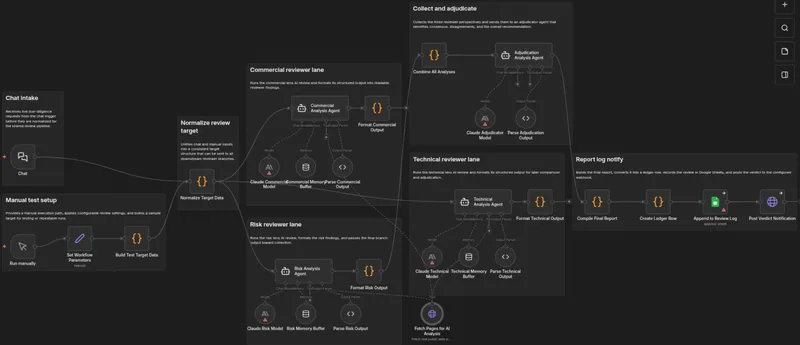
 Every agent needs to be told what it does not doGuides on multi-agent systems talk about assigning roles. We put the prompts from three of our workflows side by side and found something else in common: each one states what that agent must not do.verified August 28, 2026n8n 2.8.4Read
Technical documentation
n8n workflows that run in production
We document the automations we built for clients and for ourselves. Every write-up says what the workflow does, what it will not do, and which n8n version it was checked on.
n8n is a program for wiring company systems together without writing everything from scratch: it pulls data from one place, reshapes it and puts it into another. That sounds simple right up to the first API rate limit, the field that sometimes arrives empty, or the public register that goes quiet for an hour once a week. That is where the gap shows between a demo and something a company runs every day: the gap is not a few more blocks, it is handling every case where something fails.
This section is about that gap. There are no “connect node A to node B” tutorials here; the internet has a thousand of those. What is here is the part usually missing: which exact case breaks the flow, what the API returns when the data is incomplete, how the error path behaves, and how much work the workflow really takes off a person. Every write-up is produced after the rollout, not before it.
Each document shows who wrote it, who reviewed it and when, together with the n8n version it was tested on. That matters, because n8n moves fast and a year-old description may no longer match the interface. When something stops being true, the page gets a new verification date and a changelog entry instead of quietly going stale.
We publish the workflow files in the form we use them: JSON to import, a GitHub repo, sometimes a template on n8n.io. Take them and run them yourself. If you would rather have someone assemble it and keep it running, that is what we do, but nothing here is gated.
Documented workflows
- Every agent needs to be told what it does not doGuides on multi-agent systems talk about assigning roles. We put the prompts from three of our workflows side by side and found something else in common: each one states what that agent must not do.verified August 28, 2026n8n 2.8.4Read
 What breaks when someone imports your n8n workflowWe submitted a workflow to the n8n template library and it came back rejected over one missing property in the JSON. Six months later the same file broke three more times on our own instance, for entirely different reasons.verified July 16, 2026n8n 2.8.4Read
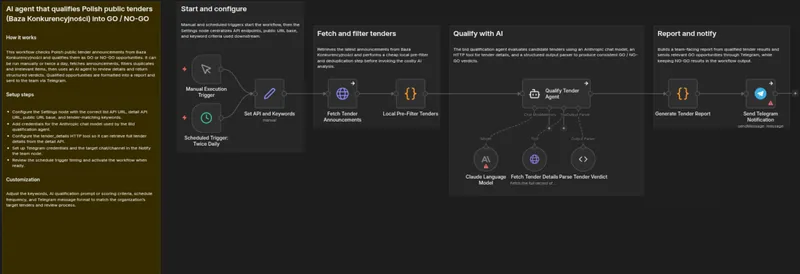
- An AI agent that qualifies Polish public tendersBaza Konkurencyjności publishes hundreds of tender notices a week and almost
none of them fit any given supplier. This workflow drops the obvious noise
locally and hands the rest to an agent that returns a GO or NO_GO decision
along with the questions worth asking the buyer.verified July 16, 2026n8n 2.8.4Read